
What Is the Role of Texture in Art? And How Scale Makes It Work Above a Sofa
Texture is the part of a painting you can see with light. Color tells you what the work is about. Texture tells you how it was made, how it will change through the day, and whether it can hold a wall from the sofa. In extra-large living rooms that last job is the important one. A flat print can look finished in a thumbnail and empty at ten feet. Texture Art exists because relief—ridges, knife cuts, built plaster—gives a large canvas a second life after the first glance.
The role of texture is not decoration. It is structure. This article explains what texture does in painting, then how sofa width and ceiling height decide whether that texture can actually be read.
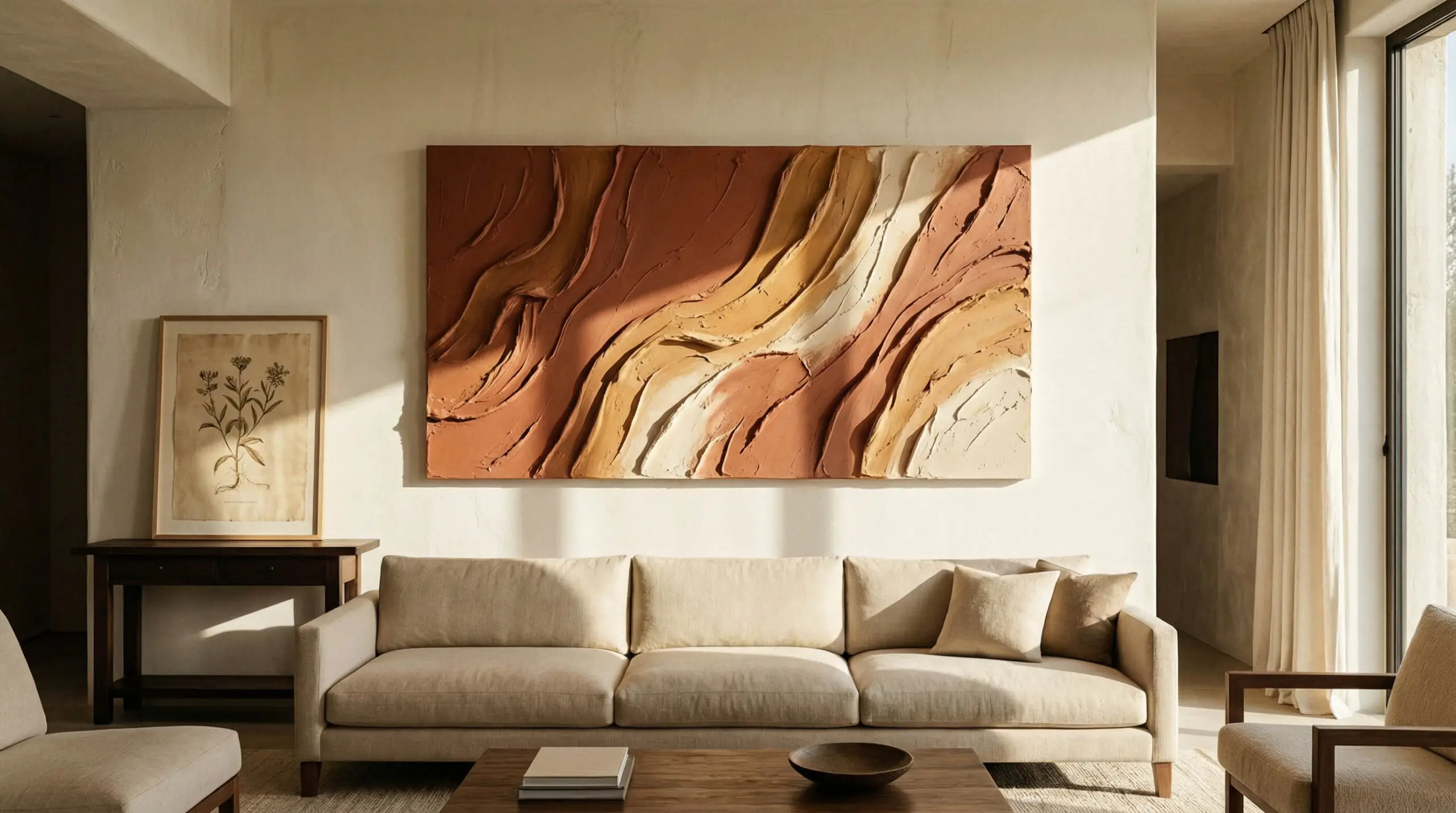
What Texture Does in a Painting
Painters use two kinds of texture. Visual texture is an illusion: a smooth surface that looks rough. Actual texture is physical: paint thick enough to cast a shadow. Impasto is the classic method for the second kind. Paint is laid on so the brush or knife remains visible. When light moves across those ridges, the surface becomes a low-relief sculpture.
That is the first role of texture: it controls light. A glossy, even plane reflects as a sheet. A built surface breaks the light into small planes. Morning sun from a side window will find every peak. Evening lamps will find different ones. The painting does not stay the same object from breakfast to night.
The second role is evidence. Thick paint records speed, pressure, and tools. Matter painting pushed this further by treating the paste itself as the subject. Viewers do not only look at an image. They look at a history of making.
The third role is presence. Abstract art often has no figure to set scale. Texture replaces that figure. A quiet beige field with real relief can hold a room that a busier, thinner print cannot. Museums have long treated surface as content. The Tate’s note on impasto describes thick paint as a way to catch light and keep the artist’s gesture visible. A MoMA discussion of hanging shows the other half of the problem: a work only reads if its size and height match the wall it occupies.
In a house, that wall is usually the sofa wall.
Why Texture Needs Extra-Large Scale
Relief is useless if the canvas is too small. A heavily built 24-inch panel over a 90-inch sofa looks like a tile sample. The eye sees furniture first and art second. Texture needs area so the ridges become a climate—clay, plaster, tide, ash—rather than a detail.
That is why Texture Art is usually extra large. The surface has to work at two distances. From the doorway it should read as one mass. From the sofa it should still offer knife marks, pits, and layered edges. If either distance fails, the work is only a color swatch.
Interior design already knows this in furniture: a texture on a pillow is local; a texture on a wall has to be architectural. Paint that pretends to be plaster only succeeds when it is sized like plaster—wide enough to belong to the seating, tall enough to belong to the room.
Sofa Width: The Horizontal Rule
Measure the sofa from arm to arm. For a sectional, measure the straight back that faces the wall.
Keep the painting at about 60–75 percent of that width. Below 60 percent, even deep texture looks timid. At full sofa width the pairing usually feels tight.
Starting ranges:
- 72–84 in sofa: textured canvas about 48–60 in wide
- 90–96 in sofa: about 60–72 in wide
- 100–140 in sectional back: about 70–95 in wide, or a multi-panel group with the same total width
Leave 6–10 inches between the sofa back and the bottom of the canvas. Keep the center near 57–60 inches from the floor in a standard room. Texture does not cancel these rules. It makes them more necessary. A high-relief work hung too high becomes a dark shelf of shadow. Hung too low, the thickest paint fights the cushions.
Pale sofas take clay, sand, warm white, and terracotta relief. Gray sofas take plaster, ash, and graphite. Dark tufted sofas can carry warmer, denser surfaces because the furniture already has visual weight.
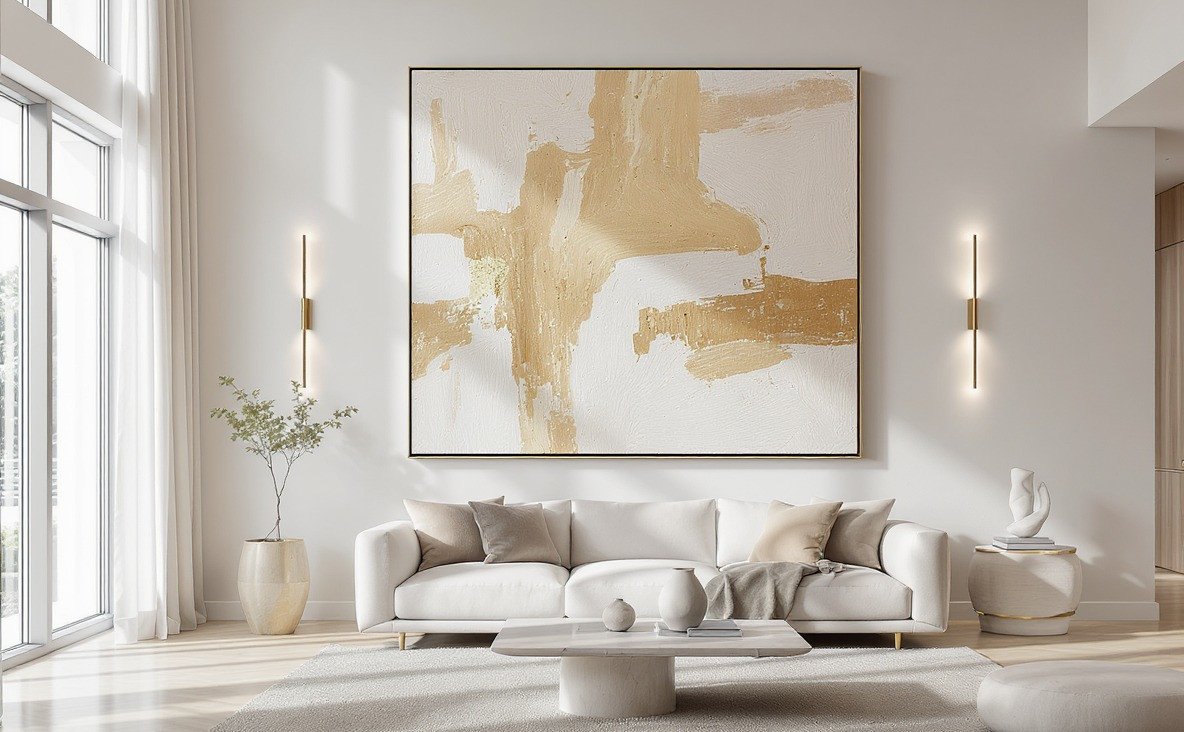
Ceiling Height: The Vertical Rule
Sofa width sets how wide the textured field should be. Ceiling height sets how tall it should be, and how aggressive the relief can be.
8-foot ceilings
A horizontal textured canvas is enough. Deep peaks are fine if the painting does not crowd the molding. Side light from a window will do more for the surface than extra height.
9-foot ceilings
Add a little vertical mass. A taller rectangle or a square lets the ridges continue upward without leaving a blank band above the work.
10–12-foot ceilings
A short, wide textured strip looks like a decorative lintel. Increase height. A large square with visible brush or knife work can hold the extra air. The relief should still be readable from the sofa, not only from a balcony.
Double-height walls
Texture must become architecture. Choose a tall canvas or a stacked pair. Keep the lower edge related to the sofa so the thickest paint stays in the human zone. Do not hang a modest textured panel halfway up a two-story wall. The empty space under it will flatten the relief you paid for.
High rooms also change lighting. Downlights from a tall ceiling can rake across impasto and make hard shadows. Test the wall at night. If the peaks go black, lower the relief or move the fixtures.
How Light Turns Texture Into Scale
A textured painting is not finished until the room’s light is part of it. North light is even and favors mid-relief. Harsh afternoon sun can bleach pale grounds and over-model deep ridges. Warm evening lamps restore the shadows.
That is why room photos matter more than crop shots. Look at Texture Art in a sofa setting, not only as a studio close-up. If the surface disappears in the room shot, it will disappear in your living room too.
The Victoria and Albert Museum displays objects in furnished interiors for the same reason: surface is judged next to furniture, not in isolation. A living room is a similar test. The sofa is the measuring stick. The ceiling is the second one.

Choosing Relief for the Room You Have
Ask how much shadow you want.
Low relief—thin knife work, scraped plaster, soft ridges—suits bedrooms, offices, and rooms with many downlights. It still reads as handmade without turning the wall into a topographic map.
Medium relief is the living-room default. It changes between noon and evening and still looks finished from the sofa.
High relief belongs to simple rooms: pale walls, few competing objects, and a single seating wall. In a busy interior it can fight the furniture.
Match materials to the house. Oak and linen sit with clay and warm white. Stone and concrete sit with ash and cool gray. Velvet and lacquer can take denser, darker impasto because those fabrics already accept drama.
A Practical Sequence
- Measure sofa width and ceiling height.
- Set art width at 60–75 percent of the sofa.
- Set art height according to the ceiling: horizontal for 8 feet, taller or square as the wall rises.
- Tape the rectangle. Sit down. If it looks small, enlarge it before you choose a thicker surface.
- Decide relief only after the rectangle is right. Texture cannot rescue a timid size.
- Check daylight and lamp light on that wall.
- Confirm whether a deep surface ships rolled or stretched. Heavy impasto does not always survive the same packing as a flat acrylic.
Conclusion
The role of texture in art is to make light, time, and handwork visible. In a living room that role only succeeds at the right scale. Sofa width decides the horizontal mass. Ceiling height decides the vertical mass. Relief then gives the canvas a surface that still works after the first look.
Choose size first. Choose texture second. A large, quietly built field above the sofa will do more than a small, heavily worked one that never leaves the sample scale.
FAQ
What is the role of texture in art?
Texture controls light, records the making of the painting, and gives abstract work physical presence. Impasto and built surfaces turn a canvas into low relief.
Is texture the same as impasto?
Impasto is one method: thick paint left in visible strokes. Texture art can also use plaster, sand, scraping, or layered grounds.
Why does textured art need to be extra large above a sofa?
Relief reads as architecture only when the canvas spans most of the seating. A small built panel looks like a sample on a long sofa.
How wide should Texture Art be over a sofa?
About 60–75 percent of sofa width, with 6–10 inches of space above the back.
How does ceiling height change textured art?
Standard rooms can use horizontal fields. Taller rooms need more canvas height so the relief does not sit under a blank storey of wall.
Does strong texture replace the need for size?
No. Texture adds visual weight, but it cannot correct a painting that is too narrow for the sofa.
What lighting is best?
Side daylight and adjustable lamps. Flat overhead light erases ridges; raking light reveals them.
Where can I see how museums talk about surface and hanging?
See the Tate on impasto and MoMA on hanging pictures.
Can I use several small textured works instead of one large canvas?
On a sofa wall, one extra-large field is usually stronger. If you use panels, measure the whole group as one width.
Where can I browse extra-large textured canvases?
Texture Art collects handmade impasto and built-surface paintings sized for sofa walls and taller rooms.