
What Is Texture Art? Actual Texture vs Visual Texture Explained
Texture Art is painting that asks the wall to do more than hold a picture. Color and drawing still matter, but the first thing the eye reads is the surface: ridges, valleys, scraped plaster, a knife track that throws a small shadow at four in the afternoon and almost disappears at noon. If the surface is only a photograph of roughness, you do not have texture art. You have an image of texture.
That distinction is older than interior hashtags. Wikipedia’s entry on texture in the visual arts splits the idea in two. Actual texture—also called physical or tactile texture—is a pattern you could feel if you were allowed to touch the object: canvas weave, sand, raised paint, cracked ground. Visual or implied texture is the illusion of that surface, drawn or printed so it looks rough while remaining flat. Texture art, as a buying category, should mean the first kind. The second kind is a picture of the first.
Tate’s glossary on impasto is the museum name for the same fact in paint. Impasto is an area of thick paint. Venetian painters used it; Rubens used it; nineteenth-century landscape painters used it. In modern painting it became almost a principle: the surface should have its own reality, not only act as a window onto another scene. Brushmark and knife-mark become a kind of handwriting. A painting that revels in that handling is called painterly. Mid-century artists such as Frank Auerbach pushed the paste so far that the picture approached relief.
Abstract art, in Tate’s definition, does not copy visual reality; it works through shape, color, form, and gesture. Texture art is often abstract because the subject is the gesture left in the paste. A rose built from thick white ridges on green still refers to a flower, but what you live with is the relief. A beige wave that never quite becomes a seascape is doing the same job with less narrative.
The Extra Large Wall Art texture collection is built on that premise: handmade extra-large canvases in oil or acrylic, knife and plaster work, clay-and-ash palettes, the occasional teal-and-rust field, painted to order so the relief in the listing photo is the relief that arrives—once the canvas is stretched.
Actual texture versus visual texture
Hold this test in mind while you scroll.
If raking light would change the work—if a window at the side of the room would draw a moving line along a ridge—the texture is actual. If the roughness looks the same under every lamp because it is only pigment pattern on a flat film, the texture is visual.
Van Gogh is the public example everyone already knows. In The Starry Night, the sky is not a smooth gradient. The paint stands up. A close look shows ropes of blue and yellow laid in the direction of the motion. That is actual texture serving an image. Texture art for a living room often drops the village and keeps the rope.
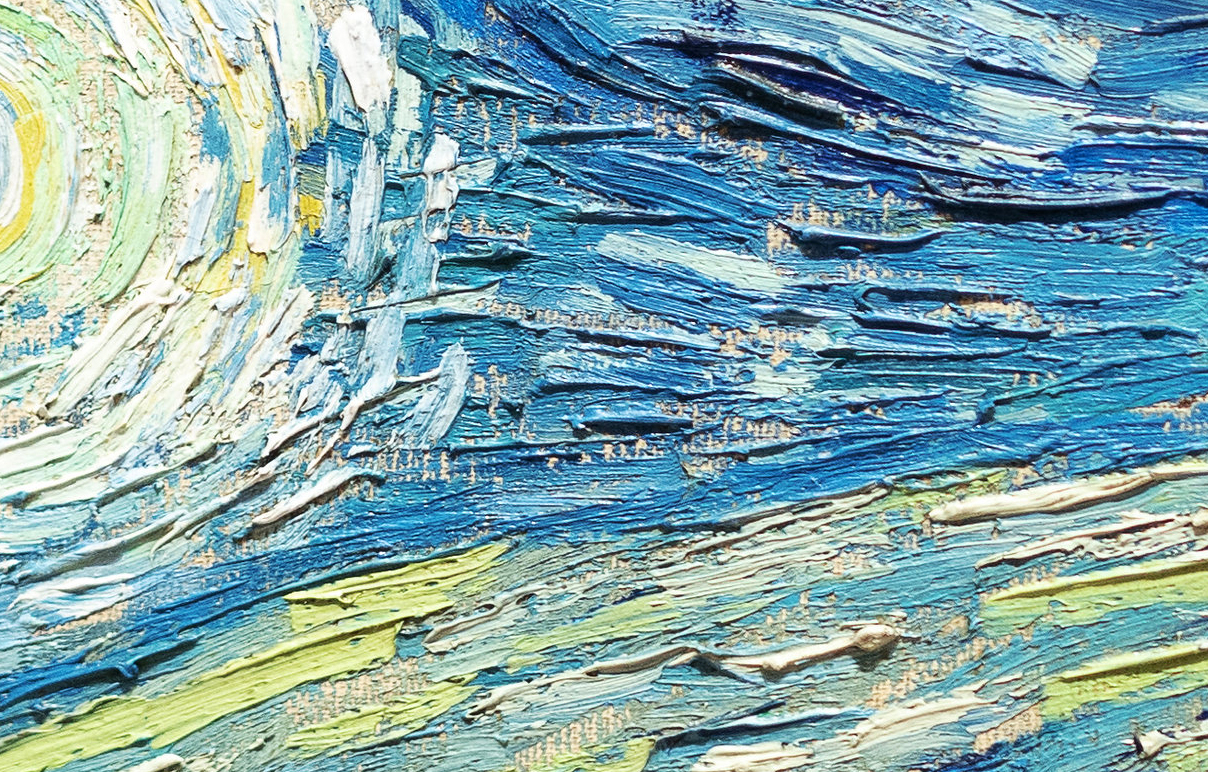
A print of that sky is visual texture: you see the idea of ridges. Standing in front of the painting, you see the ridges. Home collections live or die on whether they deliver the second experience at the size of a sofa wall.
How texture is built
Several methods show up in extra-large handmade work. They are not interchangeable.
Impasto and palette knife. Paint is left thick. A knife lays a plane, a ridge, or a dragged edge. The mark is directional. This is the closest domestic cousin to the painterly surface Tate describes.
Modeling paste and plaster. A neutral ground is built first, then stained or painted. Peaks can be higher than oil alone will hold. Deep plaster is why some pieces should not travel rolled without a plan to stretch them carefully.
Dry brush and scrape. A nearly dry brush catches only the high points of an earlier layer. A scraper reveals the color underneath. The surface stays lower than plaster, but it still changes with light.
Crackle and weathered ground. The network of breaks is part of the image if it was made in the ground and sealed. It is a defect if it happened in the tube.
Metallic leaf on relief. Gold or silver on a built surface catches light like a worn edge. On a flat print it is only a yellow shape.
Listings in the texture collection run this range: neutral layered fields for quiet bedrooms, beige-white waves aimed at coastal rooms, gray-brown rustic abstracts, black-white-gold canvases for sharper interiors, teal-and-rust weathered fields, softer blue-gray coastal hush. The names describe climate. The thing to inspect is height of surface.
Why extra-large texture is a different object
At eighteen inches, a few ridges are a detail. At sixty inches, they become architecture. Light walks across the field the way it walks across plaster or stone. That is why texture art and extra-large scale belong together. A small textured souvenir on a long wall reads as a sample. A large flat print of “texture” reads as wallpaper.
Scale still follows the furniture. Above a sofa, two-thirds to three-quarters of the sofa width remains the safest span. Texture adds visual weight, so a mid-value, high-relief canvas can hold a wall that would swallow a pale, smooth painting of the same inches. Leave about 6 to 12 inches above the sofa back. Do not hang the work toward the ceiling to “fill” a tall room; the shadows need to meet people at living height.
Pale, empty rooms can take clearer peaks. Bedrooms and offices usually want lower relief and mid values so the wall does not glitter under a downlight. Oak and linen sit with clay, sand, and warm white. Gray sofas sit with plaster and ash. Teal and rust need a simple textile field or they compete.
Light is part of the medium
Texture art without raking light is half switched off. A window to the side of the painting, or a picture light set off-axis, will show the work you paid for. Cans aimed straight at glossy peaks will glaze them. If the room has only harsh overhead lighting, choose a quieter, less glossy relief—or add a lamp.
This is also why photographs lie. A head-on product shot flattens ridges. Ask for an angled frame, or look at noon and evening on a similar wall in your house with tape on the plaster. The tape tells you size. The daylight tells you whether texture belongs there.
What texture art is not
It is not automatically wabi-sabi, though cracked earth palettes overlap. It is not automatically 3D sculpture; most of these canvases remain paintings with a built skin. It is not a print with a “textured” filter. And it is not a museum impasto by Auerbach or Van Gogh. Those works have their own scale, materials, and history. A house canvas should be an original surface in that tradition: handmade, sized to the wall, honest about how high the paste stands.
How to choose from a texture collection
- Decide how much shadow you want: clear peaks, moderate knife work, or a low scraped field.
- Match temperature to the room—warm earth with oak, cooler plaster with gray.
- Size to the sofa or the clear wall; extra-large is the point.
- Confirm the texture is built, not printed.
- Ask how a deep surface ships and how it should be stretched.
- Plan the light before you plan the frame. Deep work often looks better on a deep stretcher, unframed.
Used this way, texture art is a material decision. The wall stops being a place to hang a picture and becomes a place where paint still occupies space.
What is texture art in simple terms?
It is artwork whose surface has real physical variation—thick paint, plaster, knife ridges—so light can move across it. A flat picture of roughness is visual texture, not texture art.
What is the difference between actual texture and visual texture?
Actual texture can be felt and casts small shadows. Visual texture only looks rough. Wikipedia’s texture entry is built on that split.
Is impasto the same as texture art?
Impasto is the paint method: thick paint left standing. Texture art is the broader category and can also include plaster, crackle, and mixed grounds.
How should I light a textured painting?
Use raking light from a window or an off-axis picture light. Avoid shiny downlights aimed straight at the peaks.
How large should texture art be above a sofa?
About two-thirds to three-quarters of the sofa width. Relief already adds weight, so you do not always need the widest possible span.
Can deep texture be shipped rolled?
Sometimes, with care and a plan to stretch it. High plaster is safer discussed before you order. Ask whether the piece should travel stretched.
Does texture art work in a bedroom?
Yes, if the relief and gloss stay moderate and the values stay mid. Sharp white peaks under a bedside lamp can feel busy at night.