
How to Choose Extra Large Wall Art
The fastest way to waste a large canvas is to buy it by mood and hang it by guesswork. Extra Large Wall Art only works when two measurements are right: the width of the sofa and the height of the ceiling. Style comes after those numbers. A painting that is too narrow makes the seating look unfinished. A painting that is too short on a tall wall leaves a blank storey of plaster that the eye cannot ignore.
This is a measuring guide. It uses the two-thirds sofa rule, then adjusts height and orientation for 8-foot rooms, 10–12-foot rooms, and double-height walls.
Start With the Sofa, Not the Wall
In most living rooms the sofa is the largest object and the wall above it is the largest empty plane. Interior design treats those two surfaces as one composition. If the art does not belong to the sofa, it does not belong to the room.
Measure the sofa from the outside of one arm to the outside of the other. That is the only width that matters. For a sectional, measure the straight back that faces the wall, not the entire L-shape.
Aim for art that spans about 60–75 percent of that width. Designers call this the two-thirds rule. Below 60 percent the canvas looks like a sample. At or beyond full sofa width the furniture often looks smaller than it is.
Use these starting ranges:
- Loveseat, 48–60 in: art about 32–42 in wide
- Standard three-seater, 72–84 in: art about 48–60 in wide
- Large sofa, 90–96 in: art about 60–72 in wide
- Long sectional back, 100–140 in: art about 70–95 in wide, or a multi-panel set with the same total width
Leave 6–10 inches between the top of the sofa back and the bottom of the painting. Keep the center of the work near 57–60 inches from the floor in a standard room. That pairing—gap plus eye-level center—is what stops extra-large art from floating.
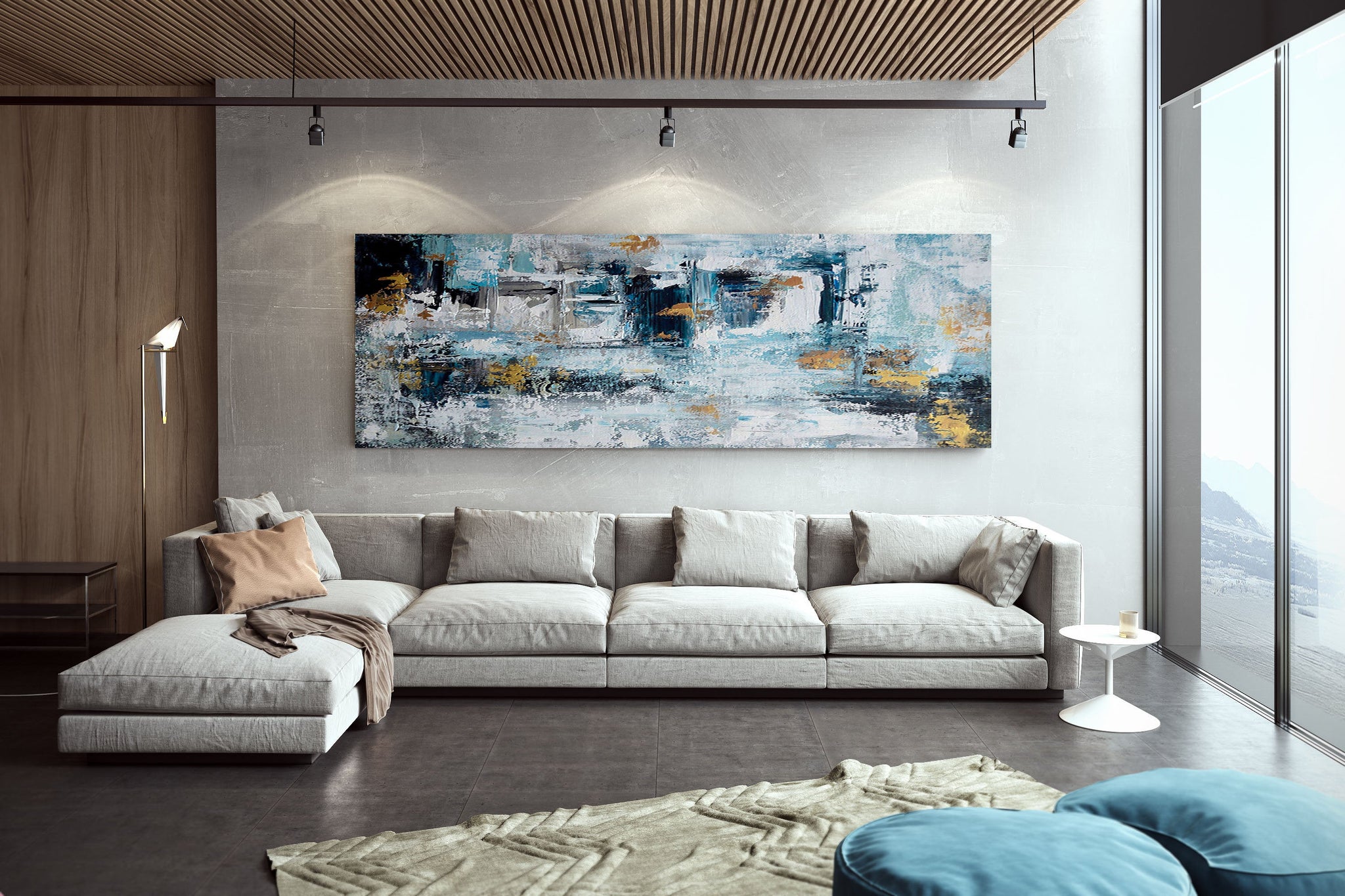
The panoramic canvas above a long sectional is the clearest example. The painting is wide enough to answer the seating line, but it still leaves a little wall on each side. That margin is part of the proportion, not leftover space.
Then Adjust for Ceiling Height
Sofa width sets how wide the art should be. Ceiling height sets how tall it should be.
This is the same problem proportion in architecture describes: a part has to relate to the whole. A 30-inch-tall painting can be correct over a sofa in an 8-foot room and still fail under a 16-foot void.
8-foot ceilings
A horizontal extra-large canvas is usually enough. Do not force a very tall vertical piece into the gap between sofa and molding. Keep a few inches of wall above the painting so it does not look jammed against the ceiling.
9-foot ceilings
You can keep a horizontal format or add a little height. A slightly taller rectangle or a square begins to look comfortable. Raise the center only a little; do not abandon the sofa gap.
10–12-foot ceilings
A wide, short painting starts to read as a strip. Increase the canvas height, choose a square, or use a vertical format. The extra air above the sofa is the unused part of the room. The art has to grow into it.
Two-story and double-height walls
Ordinary sofa-scale height disappears. Choose a tall Extra Large Wall Art canvas, a large square, or stacked panels. Keep the bottom edge related to the sofa or fireplace so the work still lives in the human zone. Do not take a modest painting and hang it halfway up the wall. Height should come from the object, not from empty space underneath it.
The golden ratio can help when you are choosing a canvas shape—roughly 1:1.618—but the sofa and the ceiling remain the real constraints. A 40 × 60 or 48 × 72 inch work often feels balanced because those sizes sit near familiar room proportions.
Horizontal, Square, or Vertical
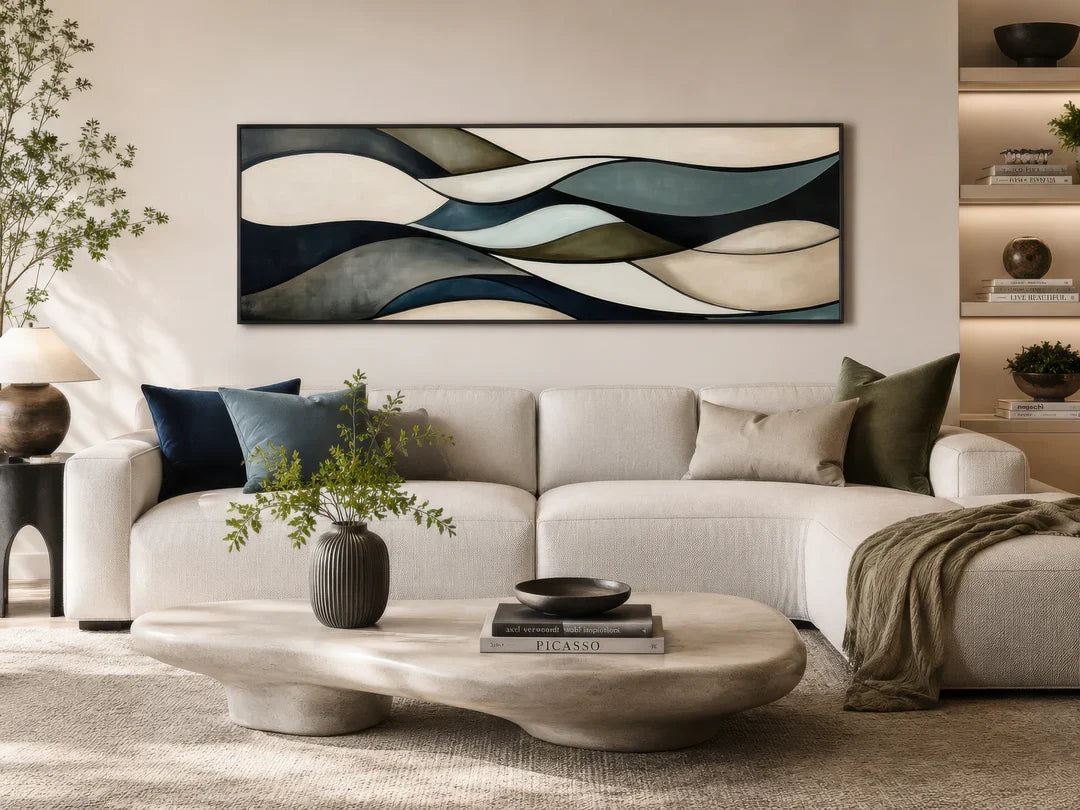
Horizontal canvases follow the sofa. They are the default for standard ceilings and long seating. A soft landscape field or a wide abstract above a three-seater is the classic living-room solution.
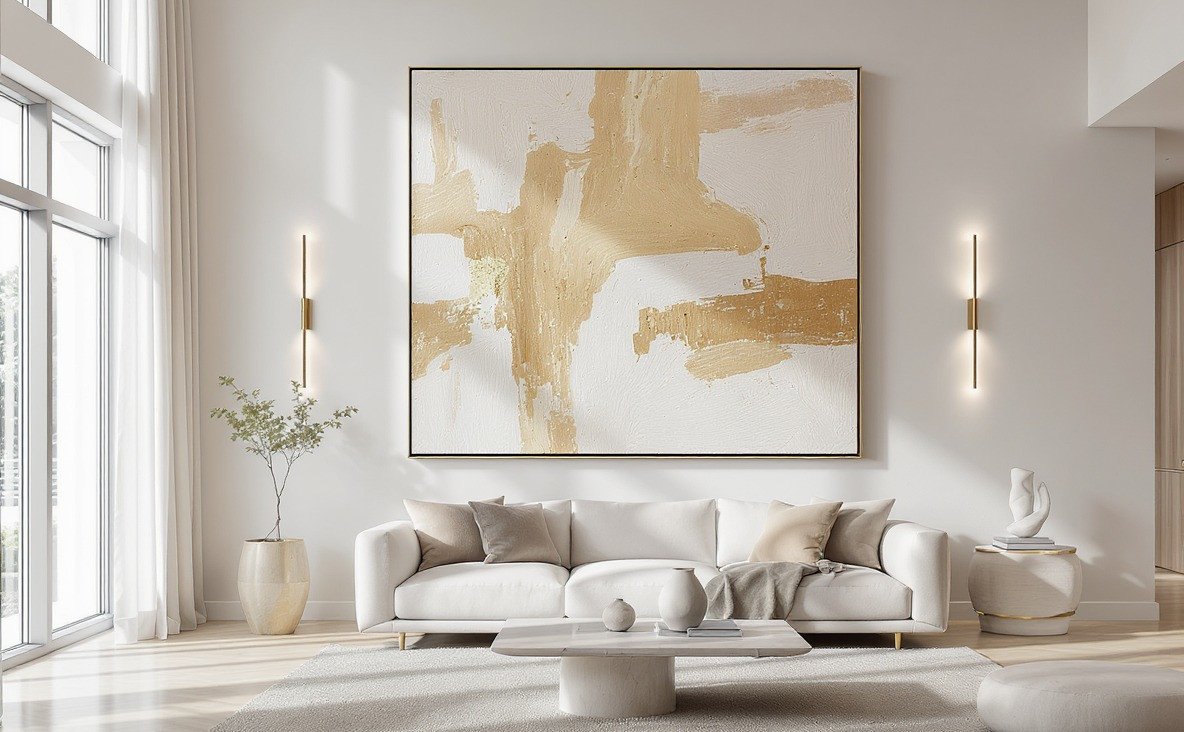
Square canvases add height without turning the wall into a tower. They are useful in rooms with 9- to 12-foot ceilings, where a short panorama looks thin and a very tall vertical may compete with windows.
Vertical canvases belong to high walls, stair volumes, and narrow piers. They pull the eye up. On an 8-foot ceiling they can feel oversized unless the sofa is small and the wall is tight.
Abstract art makes these choices more important, not less. There is no painted figure to tell the viewer how large the image is. Scale itself becomes the subject. That is why extra-large abstracts succeed in living rooms: they replace narrative with presence.
Museum hanging practice is a useful check. A MoMA discussion of picture hanging shows how wall height and neighboring objects change the way a work is seen. The Victoria and Albert Museum displays art inside rooms where furniture and architecture already set a scale. A home is not a gallery, but the rule is the same: size the painting for the body in the room—the person on the sofa and the person at the door.
A Measuring Sequence That Prevents Returns
- Measure sofa width, arm to arm.
- Multiply by 0.60 and 0.75. That is your target art width.
- Measure ceiling height and the clear wall above the sofa.
- Choose orientation: horizontal for standard rooms, taller or vertical as the ceiling rises.
- Mark a 6–10 inch gap above the sofa and a center line near 57–60 inches from the floor.
- Tape the rectangle on the wall.
- Sit on the sofa and stand in the doorway. If the tape looks timid, go larger before you go more colorful.
This is slower than clicking a thumbnail. It is also how you avoid buying a 40-inch canvas for a 96-inch sofa.
Mistakes That Show Immediately
Buying from a phone screen without converting sofa inches into canvas inches.
Hanging a short piece high “to fill” a tall wall.
Matching the painting exactly to sofa width and leaving no side margin.
Sizing a sectional as if it were a compact three-seater.
Choosing a pale, low-contrast work at the minimum width. Quiet paintings often need more area to hold the same furniture.
Visual weight matters. A dark or heavily textured canvas can balance a sofa at the lower end of the range. A misty, light field usually needs to sit at the upper end.
After the Rectangle Is Right
Then choose surface and color. Side light from a window favors palette-knife ridges and built texture. Overhead downlights flatten thin paint. In open-plan rooms the work must still read from 12–20 feet, so simple large fields usually beat busy small incidents.
Handmade oversized canvases are practical here because the size can follow the measurement instead of forcing the wall to accept a stock square. That is the point of Extra Large Wall Art: one canvas built for the sofa and the ceiling you actually have.
Conclusion
Choose width from the sofa. Choose height from the ceiling. Hang the work so it stays attached to the furniture, and only then decide on color and texture. Those two measurements will finish more living rooms than any palette trend.
Tape the size first. Order the canvas second.
FAQ
How wide should extra large wall art be above a sofa?
About 60–75 percent of the sofa width, measured arm to arm.
How much space should be between the sofa and the painting?
Six to ten inches from the top of the sofa back to the bottom of the canvas.
How does ceiling height change the choice?
8-foot rooms favor horizontal canvases. At 10 feet and above, increase the painting’s height or switch to square or vertical. Double-height walls need tall work, not a small piece hung higher.
What size works over a 90-inch sofa?
A canvas about 60–68 inches wide is a strong starting range. Adjust height to the ceiling.
Should art be wider than the sofa?
Almost never. Side margins keep the furniture and the painting in one composition.
Is vertical art better for high ceilings?
Usually yes. Height should come from the canvas, not from empty wall under a short work.
Can I use a diptych or triptych?
Yes. Measure the whole group, including gaps, and keep that total width inside the sofa ratio.
Why do museums matter for a living room?
They show that hanging height and neighboring scale change how art is read. See MoMA on hanging and room-scaled displays at the V&A.
What if I have a large sectional?
Size the art to the wall-facing back only. Extra-wide single canvases or wide multi-panel sets work better than one modest painting in the middle.
Where can I find canvases in sofa-scale sizes?
Extra Large Wall Art focuses on oversized handmade paintings that can be matched to sofa width and ceiling height.