
What Is Abstract Art?
Abstract art is painting that does not have to look like a recognizable scene. It uses color, shape, gesture, and surface as the subject. A mountain can become a band of gray. A figure can become a single dark mass. Or there may be no starting object at all—only fields, lines, and texture. That is the core of abstract art: the work is not a window onto a place. It is an object on the wall.
This matters at home because abstract painting is easy to misunderstand. People look for a story and feel they have failed when they cannot name one. The better question is simpler. Does the canvas hold the room? Does the color sit with the furniture? Does the scale finish the wall? Abstract Wall Art is the domestic form of that question: one handmade field large enough to organize a living room rather than a cluster of small leftovers.
A Short Definition Without the Jargon
The Tate’s definition of abstract art is still the cleanest public one: art that does not attempt an accurate depiction of visual reality, but uses shapes, colors, forms, and gestural marks to achieve its effect.
There are two common paths.
The first starts from the world and simplifies it. A coastline becomes horizontal bands. A forest becomes a green field with a darker edge. The painting still has a memory of place, but you are not asked to count trees.
The second starts from painting itself. Geometry, poured lines, scraped plaster, or a single color field have no job except to exist as paint. Historians sometimes call this non-objective work. In everyday rooms the distinction is less important than the result. Both kinds can calm a wall or charge it.
Abstract art is not “random.” Even a loose canvas has decisions: which color sits on top, where the eye enters, how much empty ground remains, whether the surface is thin or built. Those decisions are the content.
Where Abstract Painting Came From
Abstraction did not appear overnight. In the early twentieth century, artists pulled painting away from likeness. Cubism broke objects into planes. Fauvism pushed color beyond description. From there, painters such as Kandinsky, Malevich, and Mondrian treated color and form as independent.
After 1945, abstract expressionism made scale part of the idea. The canvas became large enough to stand in front of, not only to look at. Gesture, stain, and field replaced the small easel picture. The Met’s Heilbrunn essay on Abstract Expressionism is a reliable museum account of that shift: painting as an event on a wall-sized surface.
Two later languages still shape what people hang at home.
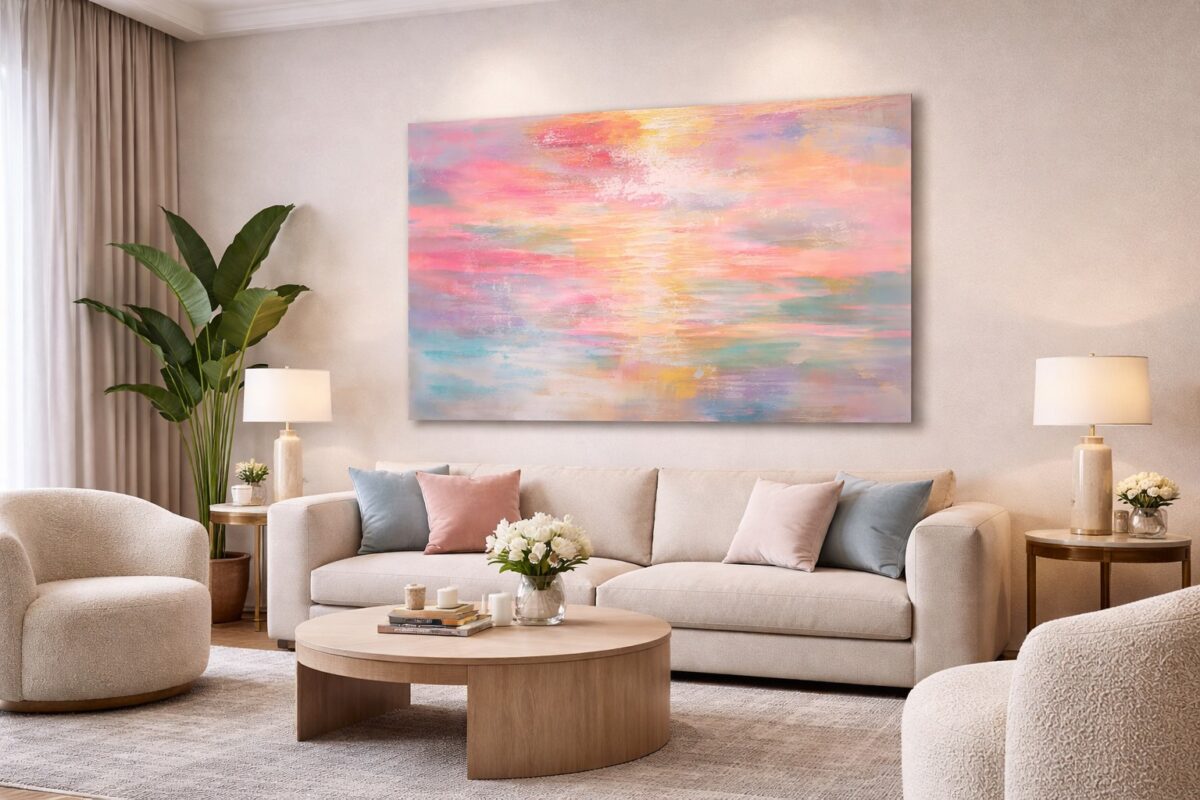
Color field painting treats large areas of hue as the subject. Soft edges, stained grounds, and quiet transitions matter more than drawing. These works often live well in living rooms because they behave like atmosphere.
Geometric abstraction uses circles, bands, grids, and hard edges. It can feel architectural. It suits rooms that already have strong lines—windows, bookcases, paneling.
Neither language is better. A gestural field can warm a pale sofa. A geometric canvas can steady a busy open plan. The room decides.
What Abstract Art Does in a Room
Because there is no depicted figure, scale and color do the work that subject matter would do in a landscape.
A small abstract on a long sofa wall looks unfinished. The eye reads the furniture first and the painting as an afterthought. A large abstract can finish the wall in one decision. That is why extra-large handmade work is the practical form of domestic abstraction. One canvas. One color climate. One surface.
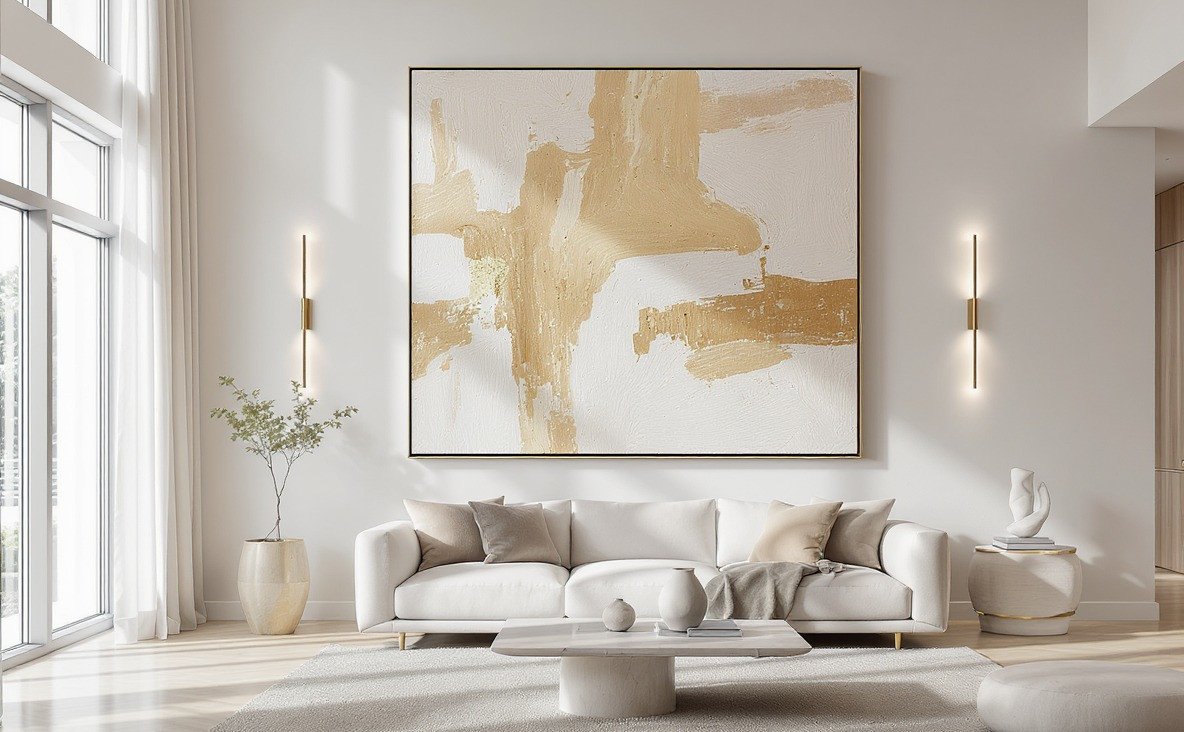
Color sets mood before anyone names a style. Soft pink, sand, and mist read as quiet. Navy and gold read as weight. Black and white read as structure. Earth and plaster read as calm. The painting does not need a title that explains this. The wall already knows.
Surface is the second language. Thin paint looks photographic from far away. Knife ridges and built grounds change with daylight. If you want a canvas that still has something to do after the first week, choose a surface you can see from the sofa.
The Victoria and Albert Museum is useful here as a reminder that objects are judged next to rooms, not only on white gallery walls. Home hanging is closer to that test than to a catalog crop.
How to Look at Abstract Painting
Stand back first. From eight to fifteen feet, ask what the whole field does. Is it a horizon? A storm? A quiet wall of one temperature? If you cannot answer in one phrase, the composition may be too busy for the room.
Then move closer. Look at edges, overlaps, and tool marks. This is where handmade work separates from a print. A print repeats a surface. A painting still has a sequence: what went down first, what was scraped, what was left.
You do not need a story. You need a relationship. If the canvas keeps sending you back to the sofa color, the curtain, or the floor, it is working. If you keep hunting for a hidden object, the painting may be half-representational and unresolved—or you may be asking the wrong question.
Choosing Abstract Wall Art for an Actual Wall
Start with the job of the room.
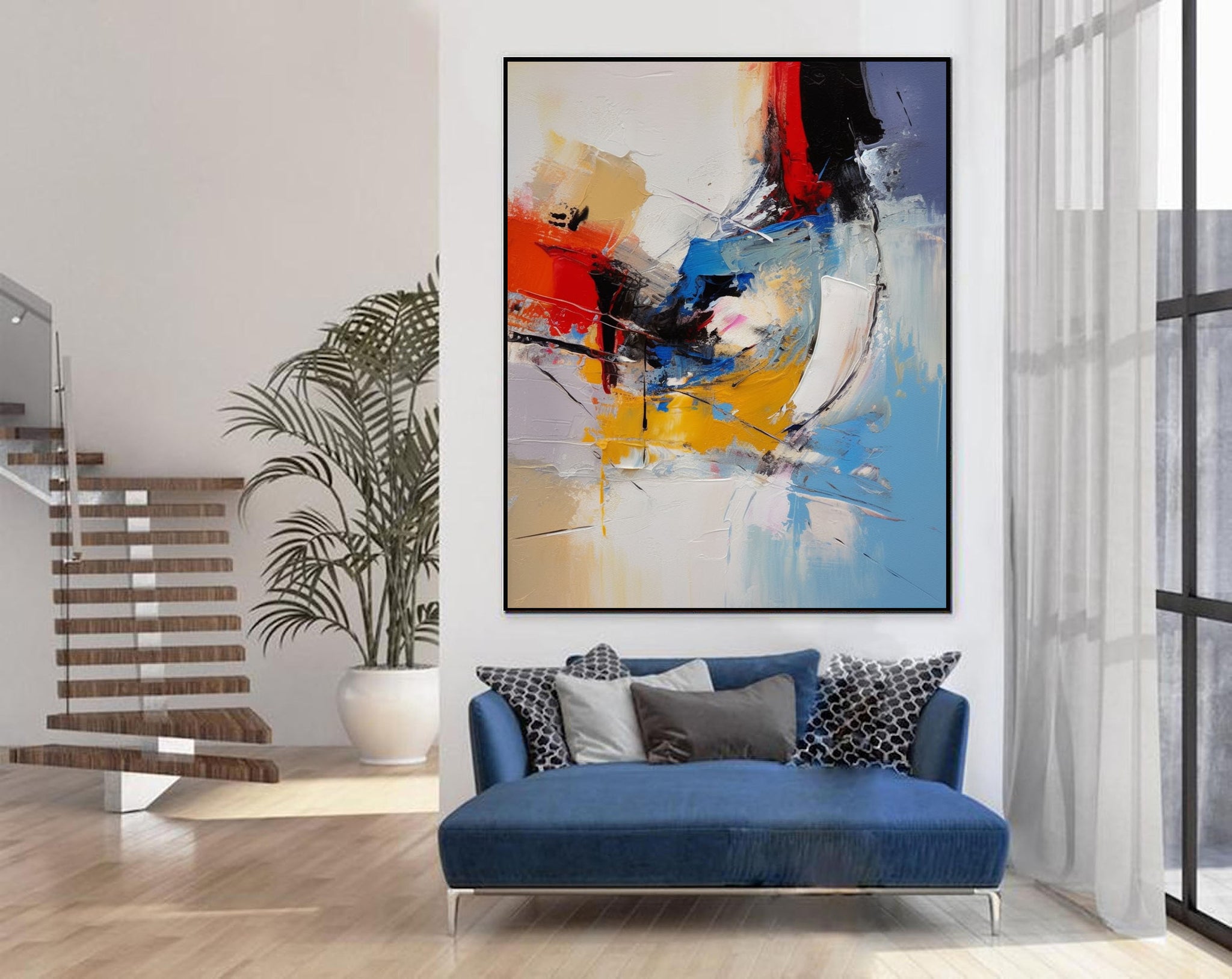
Living rooms can take a stronger field. The painting has to hold conversation distance and doorway distance at once. Horizontal extra-large abstracts suit long sofas. Tall squares and vertical canvases suit high ceilings and two-story voids.
Bedrooms usually need mid values and lower gloss. A loud abstract can keep the wall awake at night.
Offices need a surface that will not flare on camera. High varnish and heavy metallic leaf can become a light source on a video call.
Then match the house materials. Oak and linen sit with earth, warm gray, and cream. Stone and concrete sit with slate, ink, and muted blue. A white sofa can carry almost any field if the scale is right. A dark sofa often needs either contrast or a canvas with enough mass to meet it.
Format follows architecture.
- Horizontal: sofa walls, standard ceilings, long sideboards
- Square: medium-tall rooms that need presence without a tower
- Vertical: stair walls, high ceilings, narrow piers
One large work is usually stronger than a gallery of small abstracts. Several small canvases turn the wall into storage. Abstract Wall Art is built around that idea: extra-large handmade paintings meant to finish a wall rather than decorate the leftovers.
A practical width above a sofa is still about two-thirds of the furniture. That is not a style rule. It is how abstract work gets enough area to be read as a field instead of a sample.
Common Mix-Ups
Abstract is not the same as unfinished. An unresolved sketch can be non-representational and still weak.
Abstract is not the same as colorful. Many of the strongest domestic works are nearly monochrome.
Abstract is not the same as textured, though texture helps extra-large work survive daylight. A flat stained field can be fully abstract. A thick decorative swirl can still be only pattern.
Abstract is not a single period. Color field, gesture, geometry, and quiet contemporary plaster grounds all sit under the same roof. Choose the language that fits the room, not the label that sounds current.
How Museums Help Without Turning Your House Into One
Museum writing is useful when it stays specific. Tate explains the term. The Met explains how mid-century painters made scale part of meaning. Those pages will not choose your sofa color. They will stop you from thinking abstraction is a mood board.
At home, ignore salon-style stacking unless you are collecting works of similar weight. One extra-large canvas at standing eye level, connected to the furniture beneath it, is the more reliable installation. Leave air around the work. Abstract painting needs a little wall, just as it needs a little empty ground inside the image.
Conclusion
What is abstract art? It is painting that uses color, form, gesture, and surface instead of a required likeness. In a house that definition becomes practical. The canvas has to finish a wall, sit with furniture, and still be interesting after the first look.
Choose one field large enough for the room. Choose a palette that belongs to the materials you already own. Choose a surface that light can travel across. That is how Abstract Wall Art works: not as a puzzle to solve, but as a presence that makes the wall complete.
FAQ
What is abstract art in simple terms?
Art that does not have to copy a recognizable scene. Color, shape, mark, and surface are the subject.
Is abstract art the same as modern art?
No. Modern art is a historical period. Abstract art is a way of making images and can be historical or contemporary.
What is the difference between abstract and abstract expressionism?
Abstract is the broad category. Abstract expressionism is a mid-twentieth-century approach that often used large scale, gesture, and field.
Do I need to “understand” an abstract painting?
You need to see what it does in the room: temperature, weight, rhythm, and scale. A title can help, but it is not required.
Why do abstract paintings look better extra large?
Without a depicted object, size carries meaning. A small field on a long wall looks like a leftover.
What styles fall under Abstract Wall Art?
Gestural painting, color fields, quiet geometry, textured plaster grounds, and simplified landscapes that have been reduced to bands and masses.
Where can I read museum definitions?
Start with Tate on abstract art and the Met on Abstract Expressionism.
How should I hang one large abstract at home?
Keep it connected to the furniture below, with the center near standing eye level, and give the canvas enough width to finish the wall.
Can abstract art work in a traditional room?
Yes. A calm field often sits more easily with classic furniture than a literal landscape of the wrong scale.
Where can I browse extra-large handmade abstracts?
Abstract Wall Art collects oversized handmade canvases in horizontal, vertical, and square formats for the wall you actually have.