
Wabi Sabi Large Abstract Neutral Wall Art
A large neutral canvas can quiet a room or simply look unfinished. The difference is whether the surface has been allowed to stay slightly incomplete. Wabi sabi art in a home collection is usually extra-large abstraction in clay, bone, ash, and spare gold—handmade, often built with plaster or a knife. The phrase is Japanese. The object on your wall is contemporary canvas. Use the first as a standard for the second, or the words become a beige label.
Wabi-sabi, as Wikipedia defines it, is an aesthetic of beauty that is imperfect, impermanent, and incomplete. Wabi is subdued, austere beauty; sabi is the patina time leaves. The idea draws on Buddhist attention to flux. In objects it shows up as asymmetry, roughness, economy, and an acceptance of marks that a showroom finish would sand away. A tea bowl can lean. A painting can thin toward one edge. Neither is a mistake if the irregularity belongs to the making.
What the tea room still teaches a living-room wall
The Met’s essay on the Japanese tea ceremony explains the sixteenth-century turn toward wabi. Tea masters such as Sen no Rikyū began to value rustic Korean and Japanese vessels—Shigaraki, Bizen, later Raku—beside older Chinese treasures. Farmer’s jars with ash glaze, warped mouths, and unpredictable firing marks were raised to the same seriousness as polished heirlooms. The point was not poverty as style. It was a refusal to let smoothness be the only proof of care.
That is the test for large abstract neutral wall art. A six-foot canvas in warm gray can be as proud as lacquer if the surface is even and optical. It can be wabi-sabi if the gray is slightly dirty, the field slightly off-center, the plaster slightly cracked where the paste dried, and the gold—if there is gold—sits like a worn edge rather than a stripe of jewelry.
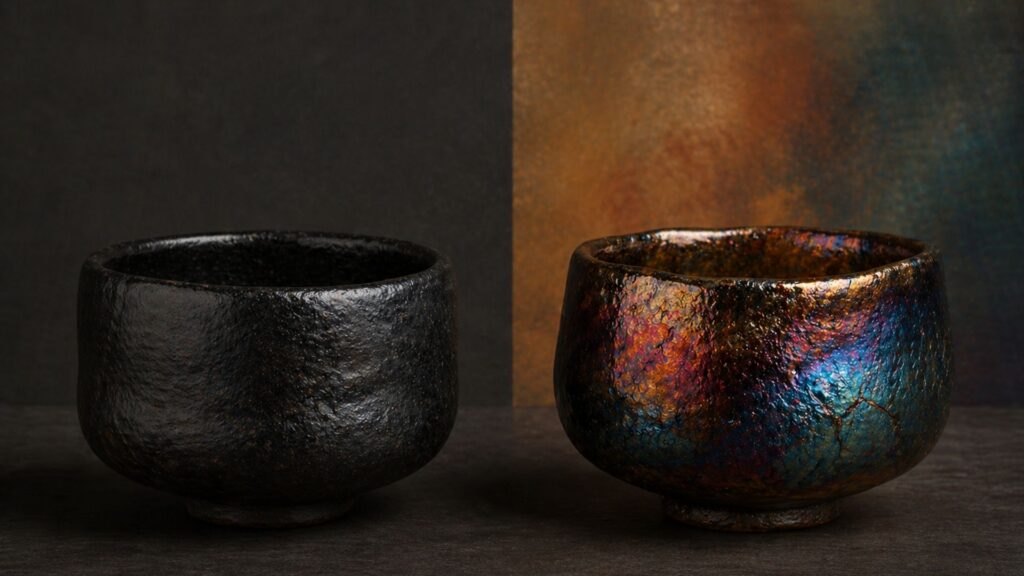
Raku bowls keep the lesson small: irregular rims, lived surfaces, color that arrived in the fire rather than in a catalog. A wall canvas cannot copy a bowl. It can copy the permission to stop before the object becomes sleek.
The Met’s note on seasonal imagery in Japanese art adds a second check. Painters treated blossom, haze, geese, and snow as ways to speak about time passing. Neutral wall art does not need a cherry tree. It does need to look as if light and years could mark it: matte rather than showroom gloss, earth rather than neon, a surface that reads differently at 4 p.m. than at noon.
Large, abstract, and neutral—three conditions that must agree
Large. Wabi-sabi is not automatically small and modest. A tea room is intimate; a sofa wall is architectural. Extra-large work is humble when it finishes the wall in one quiet field instead of a scatter of small “zen” prints. Above a sofa or bench, two-thirds to three-quarters of the furniture width still applies. Leave 6 to 12 inches above the back. Do not raise the canvas toward a high ceiling to fill empty plaster. The empty band is part of the composition, the way raked gravel is part of a garden.
Abstract. Narrative flowers and mountain scenes pull the eye into illustration. Abstraction lets the wall stay a wall: shape, value, and surface. Hint at earth, water, or worn plaster if you must, but the painting should hold if you forget the reference.
Neutral. Bone, clay, ash, warm gray, olive-brown, soot, and a spare thread of ink or gold. Neutral is not the absence of decision. It is a limited temperature. Ivory sits with oak and linen. Cool plaster-white sits with stone and gray paint. Mixing an optical bright canvas with honey floors is the most common failure in this category.
The Extra Large Wall Art wabi-sabi collection is built on those three: handmade extra-large abstracts, cracked or built grounds, earth palettes. Judge each listing by whether the irregularity is in the material.
Surface is the subject
If raking light would not change the work, it is not this aesthetic. Ask for an angled photograph. Modeling paste, scraped plaster, dry-brush over a built ground, a crackle that was made in the layer and sealed—these are actual texture. A printed “plaster look” is visual texture. At extra-large size the difference shows within a week.
Gold leaf is allowed only when it behaves like kintsugi’s idea, not like trim: a repaired edge, a thin worn line. A metallic block on a smooth beige field is contemporary luxury art. Call it that and hang it in a different room.
Asymmetry matters more than people expect. A perfectly centered motif on a glossy rectangle fights the tea-bowl logic. A field that fades on one side, or a darker bar that sits slightly off-center, is closer.
The garden as a hanging diagram
A dry landscape garden is not décor for the canvas. It is a diagram of how much emptiness a strong object needs.
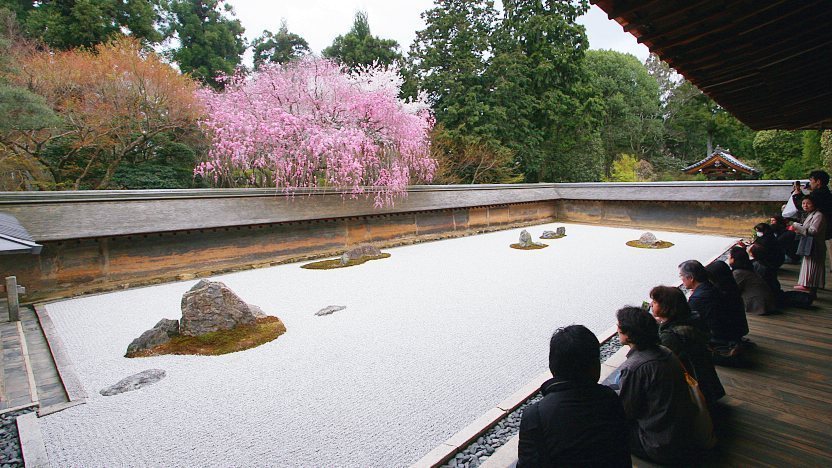
At Ryōan-ji in Kyoto, a few stones sit in raked gravel inside a low wall. The composition works because most of the rectangle is left alone. Hang a large neutral abstract the same way: one canvas, generous plaster around it, no competing gallery of small frames on the same sightline. A pair is possible if the gap stays tight and the two panels share one ground. A cluster of beige prints is the opposite of this taste.
Light is part of the medium. A side window or an off-axis lamp will travel the ridges. Overhead cans aimed at glossy peaks will glaze them. If the room has only harsh downlights, choose lower relief and a matte skin—or add a warmer lamp.
Rooms that already speak the language
Oak, linen, raw plaster, stone, and unstained wood are already halfway there. High-gloss lacquer, chrome, and sharp black metal can still take a quiet field if the rest of the wall stays simple. They will flatten the surface you paid for if every other finish is machine-smooth and the painting is the only handmade thing—and even then the painting can work, provided the light is kind.
Bedrooms want mid values and lower peaks. Offices want a surface that will not flare on camera. Entries can take a tall vertical field at standing eye level. Living rooms can take the largest span, still tied to the sofa.
What this category is not
It is not minimalism, which often wants industrial evenness. It is not distress added with a sponge for a trend photograph. It is not a museum tea bowl and not a scroll in an alcove. It is a contemporary extra-large canvas that has learned to stop.
A short buying and hanging order
- Require actual relief you can see in side light.
- Keep the palette to earth, ash, and one quiet accent.
- Size extra-large to the furniture, then leave plaster around it.
- Hang for living height, not for the cornice.
- Light from the side.
Chosen that way, wabi sabi large abstract neutral wall art is a standard for restraint. The painting should look as if it could stay while the rest of the house changes around it.
What is wabi sabi large abstract neutral wall art?
It is extra-large handmade abstraction in restrained earth colors, with a surface that stays slightly irregular—plaster, knife marks, or sealed crackle—rather than a smooth beige print.
Is beige minimalism the same as wabi-sabi?
No. Minimalism can be perfectly even. Wabi-sabi needs evidence of making and of time: uneven paint, a field that is not optically centered, a matte skin.
How large should the canvas be above a sofa?
About two-thirds to three-quarters of the sofa width. One quiet extra-large field is closer to the aesthetic than several small frames.
Can gold appear in wabi sabi art?
Yes, if it reads as a worn or repaired edge. A large metallic panel usually belongs with luxury contemporary art.
How should I light a textured neutral canvas?
Use raking daylight or a picture light set off-axis. Straight-on downlights flatten ridges and can glare.
Does the painting need Japanese imagery?
No. Cherry blossoms and calligraphy are optional and often distracting. The useful inheritance is restraint, irregularity, and a surface that can take time.