
The Textured Language of Blue and White: Appreciating Blue White Large Palette Knife Abstract Painting Modern Canvas Art Yp109
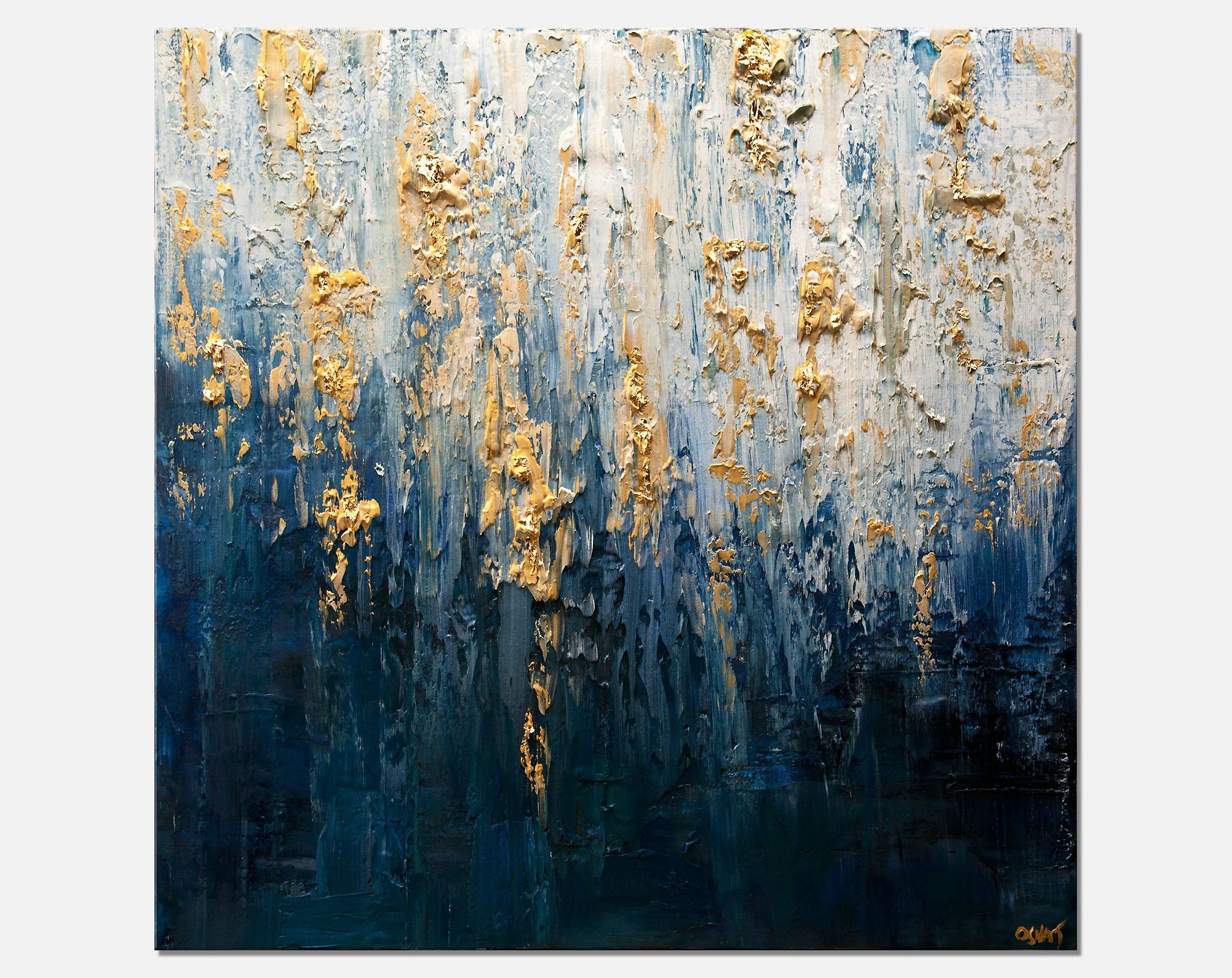
In a contemporary interior defined by polished marble floors, warm wood paneling, and clean architectural lines, a large vertical canvas commands the wall. Thick ridges of paint catch the light from recessed fixtures below, creating shifting highlights across a surface of deep blues, soft whites, charcoal grays, and intermittent gold accents. The work is unmistakably the product of a palette knife rather than a brush. This is Blue White Large Palette Knife Abstract Painting Modern Canvas Art Yp109, a handmade acrylic or oil painting on canvas that demonstrates how physical texture and restrained color can generate both energy and calm.

The composition rises vertically, with layered strokes that move upward and diagonally across the surface. Broad sweeps of white and pale gray form luminous passages, interrupted by denser zones of navy and indigo. Darker, almost black areas anchor the lower and upper edges, while flecks and scrapes of gold introduce moments of unexpected luminosity. The overall effect is one of controlled turbulence—a visual equivalent of weather systems or geological strata viewed at close range. Nothing is smoothed; every mark retains the physical evidence of the knife that applied it.
Palette knife painting has a long and respected history. Artists have long used the flexible metal blade not only to mix paint but to apply it directly, creating the thick, sculptural surfaces known as impasto. In the mid-twentieth century, Abstract Expressionists such as Clyfford Still made the palette knife central to their practice. Still applied dense layers of pigment with the blade, producing jagged, interlocking forms and highly textured surfaces that emphasized the materiality of paint itself. His works often feature dramatic vertical thrusts against dark fields, a structural sensibility that resonates with the ascending energy of the present canvas. The knife allows the artist to build, scrape, and layer in ways a brush cannot, producing edges that are crisp yet irregular and surfaces that invite both optical and tactile engagement.
In Blue White Large Palette Knife Abstract Painting Modern Canvas Art Yp109, that material intelligence is fully on display. The white passages appear almost sculpted, their raised edges casting small shadows that change with the angle of light. Blue is applied in varying thicknesses—sometimes as translucent veils over earlier layers, sometimes as opaque blocks that sit assertively on the surface. The gold accents, applied sparingly, catch light like mineral deposits in rock or brief flashes of sunlight through cloud. These metallic notes prevent the cool palette from becoming austere; they introduce a quiet warmth and a sense of discovery as the viewer’s eye moves across the painting.
Color plays a decisive role in the work’s emotional register. Blue has long been associated with depth, reflection, and expansive space. In this painting the blues range from near-black indigo to softer cerulean, creating both weight and atmosphere. White functions as both light and structure, cutting through the darker zones and opening visual pathways. The limited palette—primarily blue, white, gray, and gold—gives the work a sense of refinement while allowing the texture to carry much of the expressive load. The result is neither purely serene nor aggressively energetic. Instead it occupies a middle ground: dynamic enough to hold attention, restrained enough to coexist with modern interiors.
Scale amplifies these qualities. As a large-format canvas, the painting operates almost architecturally. It does not merely decorate the wall; it activates the vertical space of the room, drawing the eye upward and establishing a strong focal presence. In the photographed interior the work sits comfortably against a textured concrete-like wall, its cool tones balancing the warmer wood panels nearby. The painting’s vertical orientation echoes the height of the space while its textured surface provides a counterpoint to the smooth, reflective floor. This interplay of materials—thick paint against polished stone, organic marks against geometric architecture—is part of what makes the piece effective in contemporary settings.
The technique itself rewards close looking. Palette knife marks cannot be fully appreciated from a distance; one must approach the surface to see how layers overlap, how the blade has dragged through wet paint, and how earlier colors emerge through later scrapes. This physical engagement is central to the pleasure of the work. Unlike smooth, brush-blended surfaces that resolve into an image, the textured abstract remains insistently material. It asserts the presence of the hand and the decision-making process of the artist. In an era of digital imagery and mass-produced prints, such evidence of direct, physical making carries particular value.
Historically, the use of the palette knife connects this contemporary canvas to broader currents in modern painting. From Gustave Courbet’s earthy landscapes to van Gogh’s expressive skies and the dense surfaces of Abstract Expressionism, the knife has served artists seeking greater immediacy and material presence. The current work continues that lineage while remaining firmly of its time: its cool, sophisticated palette and architectural scale suit the clean, light-filled interiors of the twenty-first century.
In practical terms, the painting’s handmade quality and custom-size options make it adaptable to a range of spaces. Whether installed in a formal living area, a modern dining room, or a quiet study, it brings both visual weight and atmospheric nuance. The gold accents catch ambient light at different times of day, ensuring that the surface continues to reveal new details. Because the work is primarily cool in tone, it pairs well with neutral furnishings, natural materials, and soft lighting, allowing it to function as a calming yet substantial presence rather than a disruptive element.
Ultimately, Blue White Large Palette Knife Abstract Painting Modern Canvas Art Yp109 succeeds because it trusts the expressive capacity of texture and limited color. It does not rely on narrative or recognizable forms. Instead it offers a field of physical marks that the eye can explore at leisure. The vertical energy of the composition, the interplay of opaque and translucent layers, and the quiet glints of gold combine to create a work that feels both contemporary and connected to the longer history of painted abstraction. In a well-designed interior it becomes more than decoration: it becomes a surface for sustained looking, a reminder of the tactile intelligence that remains one of painting’s enduring strengths.
The Blue White Large Palette Knife Abstract Painting Modern Canvas Art Yp109 exemplifies how modern abstract painting continues to find new vitality through traditional tools and a refined sense of material presence.
FAQ
What is palette knife painting? It is a technique in which paint is applied, scraped, and layered with a flexible metal blade rather than a brush, producing thick, textured surfaces known as impasto.
Why does this painting feel both energetic and calm? The vertical, directional strokes create movement, while the limited cool palette of blues, whites, and grays provides visual rest and atmospheric depth.
How does the gold function in the composition? The sparse gold accents introduce warmth and catch light, preventing the cool palette from becoming austere and adding subtle points of visual interest.
Is the work suitable for modern interiors? Yes. Its large scale, textured surface, and refined blue-white palette complement clean architecture, neutral furnishings, and natural materials.
Does the painting belong to Abstract Expressionism? It draws on the material and gestural traditions of Abstract Expressionism—particularly the palette-knife surfaces of artists such as Clyfford Still—while remaining a contemporary work suited to present-day spaces.
Can the painting be customized? According to the maker, multiple sizes are available and custom dimensions can be ordered to fit specific wall proportions.