
How to Pair a Sofa with Extra Large Abstract Art
The sofa wall is the center of most living rooms. It is the first surface guests see when they sit down, and it is usually the widest stretch of empty wall in the house. A small print above a long couch looks unfinished. A properly scaled abstract canvas turns the seating area into one composition: furniture below, painting above, both sharing the same visual weight.
That pairing is why extra-large abstract work belongs over a sofa more often than over a console or a fireplace. The sofa is already a long, horizontal form. A wide painting continues that line instead of fighting it. Color and texture can pick up a pillow or a wood tone without illustrating a scene that competes with the room. Collections of Extra Large Wall Art are built around this problem—handmade canvases in widths that can be matched to a three-seater, a sectional, or a low mid-century couch.
Proportion Comes First
The rule that holds up in practice is simple: the artwork should span about two-thirds to three-quarters the width of the sofa. An 84-inch sofa wants a painting roughly 56 to 63 inches wide. A 96-inch sofa can carry 64 to 72 inches. A sectional’s longest back often needs 80 inches or more. Anything much smaller reads as a stamp on an envelope. Anything wider than the sofa itself starts to swallow the furniture.
Height is the second measurement. Leave 6 to 10 inches between the top of the sofa back and the bottom of the frame. Closer than that and people risk brushing the canvas when they sit. Farther than 12 inches and the painting floats, disconnected from the seating. Guides from The Spruce use a similar 6-to-12-inch gap so art stays related to the furniture rather than isolated on the wall. When the two rules conflict, the gap above the sofa should win.
Center the painting on the sofa, not on the wall, if the couch is offset. Tape the outline first. Living with a paper rectangle for a day is cheaper than hanging the wrong size.
What the Sofa-and-Painting Pairing Looks Like
A cream or white sofa is the most flexible partner. It acts as a frame. A large gold-and-ivory abstract above a pale couch keeps the room light while still giving the wall a clear focal point. The painting can be square and monumental or long and panoramic; the light upholstery will support either format.
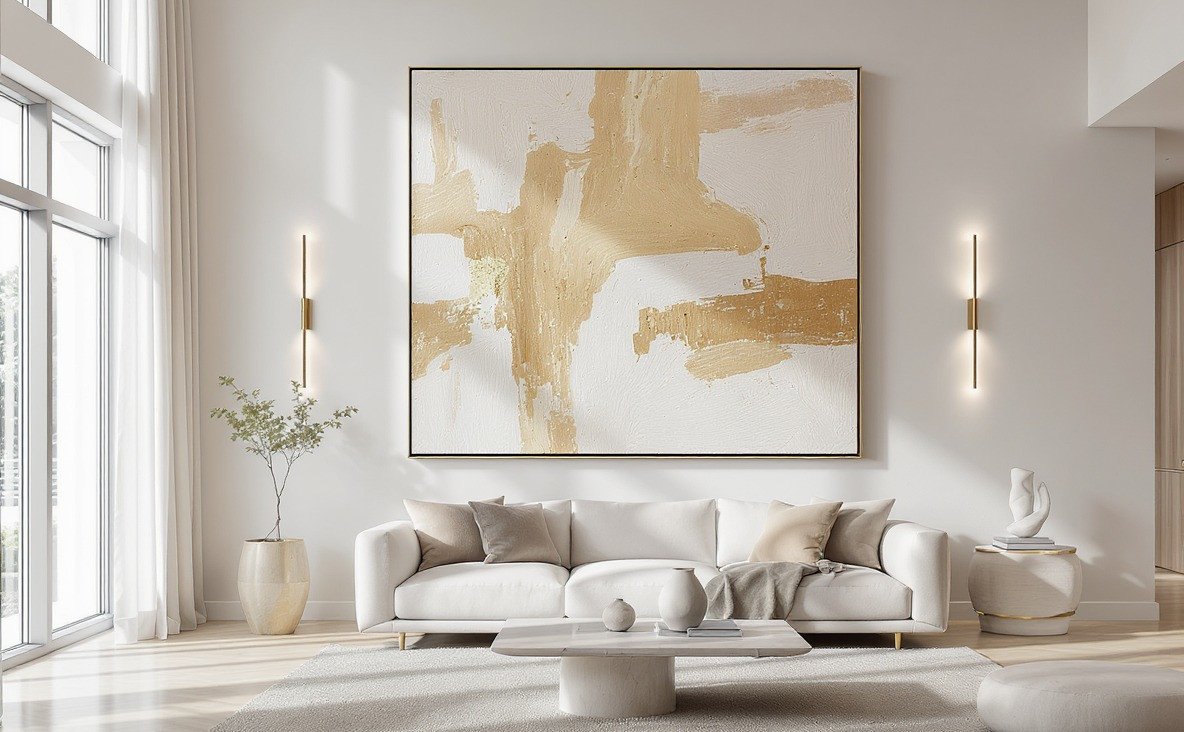
A dark sofa needs the opposite strategy. Black velvet or charcoal leather already carries visual weight. A painting that is also dark can collapse into the furniture. Warm, luminous abstracts—ambers, rusts, golds—lift the wall and keep the pairing from going heavy. Horizontal formats work especially well here because they match the sofa’s length without adding more darkness at the sides.
Sectionals change the geometry. The art should be centered on the main seating run, not on the entire L. A long, calm composition with layered blues, greens, and cream can balance a large modular sofa without competing with the extra cushions. Repeat one color from the canvas in a throw or a pair of pillows so the pairing feels planned.
Designers quoted in Architectural Digest often recommend that art occupy about 75 percent of the sofa’s width. That slightly more generous scale is useful on sectionals, where the furniture already dominates the room.
Color Temperature, Not Exact Matching
The sofa and the painting do not need to share a color. They need a relationship of temperature and contrast.
Light sofas accept almost any abstract palette: navy and gold, teal and rust, black-and-white gesture, or soft pink and blue. Dark sofas need a lighter ground or a clear warm band so the wall does not go flat. If the sofa is already a statement color—navy velvet, rust linen—keep the painting more restrained and let one accent from the canvas reappear in a pillow.
Soft sunset abstracts work well above beige seating because they add warmth without demanding a matching scheme. Cooler blue-and-gold work sits naturally above a blue sectional, as long as the canvas still contains enough white or cream to keep the wall from feeling enclosed.
Texture matters as much as hue. Palette-knife ridges and layered acrylic change with the light. A flat print of the same image rarely has that presence on a wide wall. Hand-painted Extra Large Wall Art keeps that surface quality at the scale a sofa actually needs.
Sofa Types and What They Ask For
A standard three-seater is the classic case. One horizontal canvas is almost always better than a row of small frames. The single piece keeps the wall calm and the seating area monumental.
A large sectional needs either one very wide canvas or a diptych whose total width still follows the two-thirds rule. Center on the longest back. Leave the chaise side quieter.
A mid-century sofa with exposed legs and a low back looks best with a slightly lower hang and a more graphic painting. The furniture already has a strong silhouette; the art should not float far above it.
A curved or organic sofa benefits from abstracts with movement rather than rigid grids. Sweeping brushwork follows the furniture’s line. Hard geometric blocks can look stiff against a rounded back.
In every case, pillows should support the painting. If the canvas is busy, keep cushions solid. If the canvas is spare, one patterned pillow can pick up a secondary color.
Lighting, Frames, and the Rest of the Room
Large paintings need light that grazes the surface. Sconces flanking the sofa, a dimmable picture light, or a floor lamp that washes the wall will bring out texture after dark. Overhead spots aimed straight at a glossy canvas create glare. Warm bulbs, around 2700–3000K, are kinder to gold leaf and earth tones than cool daylight LEDs.
Framing is optional. Gallery-wrapped canvas with painted edges looks current above a modern sofa. A thin black or natural-wood frame adds definition without bulk. Heavy ornate frames rarely help an extra-large abstract; they fight the scale.
Keep the rest of the sofa wall relatively clear. Lamps and a plant can sit in the same zone. Extra small pictures on the same wall usually weaken the pairing. The sofa and the canvas should read as one unit.
Mistakes That Break the Pairing
Buying too small is the first. People underestimate how much wall a sofa occupies. Hanging too high is the second—following the empty-wall 57-inch rule without adjusting for furniture. Centering the painting on the wall instead of on the sofa is the third, when the couch is not centered.
A gallery wall is not automatically a substitute for scale. A cluster of small works can look busy and still fail to match the sofa’s width. If you prefer multiple pieces, treat them as one measured block with tight, even gaps.
Weight is the last practical issue. Extra-large stretched canvases need hardware rated for the load—anchors, multiple hooks, or a French cleat. A single nail is not enough.
How to Decide Before You Buy
Measure the sofa first. Write down the target width (two-thirds to three-quarters). Then shop for abstract work in that range instead of falling in love with a 30-inch print and hoping it will do. Custom sizes exist because living rooms are not all the same.
After the painting is up, edit the seating area. Remove extra pillows that fight the palette. Check from the opposite wall whether sofa and art still read as one composition. If they do, the pairing is working.
A sofa without a counterpart on the wall looks like furniture waiting for a room. A well-scaled abstract painting gives it that counterpart—and gives the living room a finished center.
Frequently Asked Questions (FAQ)
Q: How wide should abstract art be above a sofa?
A: Two-thirds to three-quarters of the sofa’s width. An 84-inch sofa typically needs about 56–63 inches of art; a 96-inch sofa can take 64–72 inches.
Q: How high should I hang the painting?
A: Leave 6 to 10 inches between the top of the sofa back and the bottom of the artwork so the two stay visually connected.
Q: Is one large painting better than several small ones?
A: Usually yes. One extra-large canvas creates a clearer focal point. Multiple pieces work only if their combined width still follows the two-thirds rule.
Q: Should the painting match the sofa color?
A: No. Match temperature and contrast. Light sofas accept most palettes; dark sofas need a lighter ground or a warm accent so the wall does not go flat.
Q: What orientation works best above a couch?
A: Horizontal formats usually succeed because they echo the sofa’s length. Squares can work over sectionals; tall verticals rarely do unless the wall is unusually high.
Q: Can extra-large art hang on drywall?
A: Yes, with hardware rated for the weight. Use anchors, multiple hooks, or a French cleat—not a single nail.
Q: Should I center the art on the wall or on the sofa?
A: Center it on the sofa. The furniture is the visual anchor.
Q: Do textured paintings work better than prints above a sofa?
A: Hand-painted or heavily textured work often holds up better at extra-large scale because the surface changes with the light.
Q: How do I test size before buying?
A: Tape the proposed width and height on the wall and view it from the opposite seat. If the outline still looks small, go larger.