
The Enigmatic Allure of Blue Abstract Painting: From Pollock's Mysteries to Modern Masterpieces
Blue abstract painting holds a mesmerizing place in the art world, evoking emotions ranging from serene tranquility to profound introspection. As a color, blue has long symbolized depth, infinity, and the subconscious, making it a favorite among abstract artists who seek to transcend literal representation. Whether splashed across vast canvases or layered in subtle gradients, blue abstract works invite viewers into a realm of pure form and feeling. For those inspired to bring this timeless aesthetic into their homes, explore a curated collection of Blue Abstract Painting pieces that capture the essence of this genre in oversized formats perfect for contemporary spaces.
The roots of blue abstract painting trace back to the early 20th century, when pioneers like Wassily Kandinsky began experimenting with non-representational art. Kandinsky, often credited as the father of abstraction, viewed blue as a spiritual hue that "draws away from the spectator" and evokes the infinite. In works like Blue Segment (1921), he used deep indigos and ceruleans to create rhythmic compositions that mirrored musical harmonies. This synesthetic approach influenced generations, setting the stage for blue's dominance in abstract expressionism.
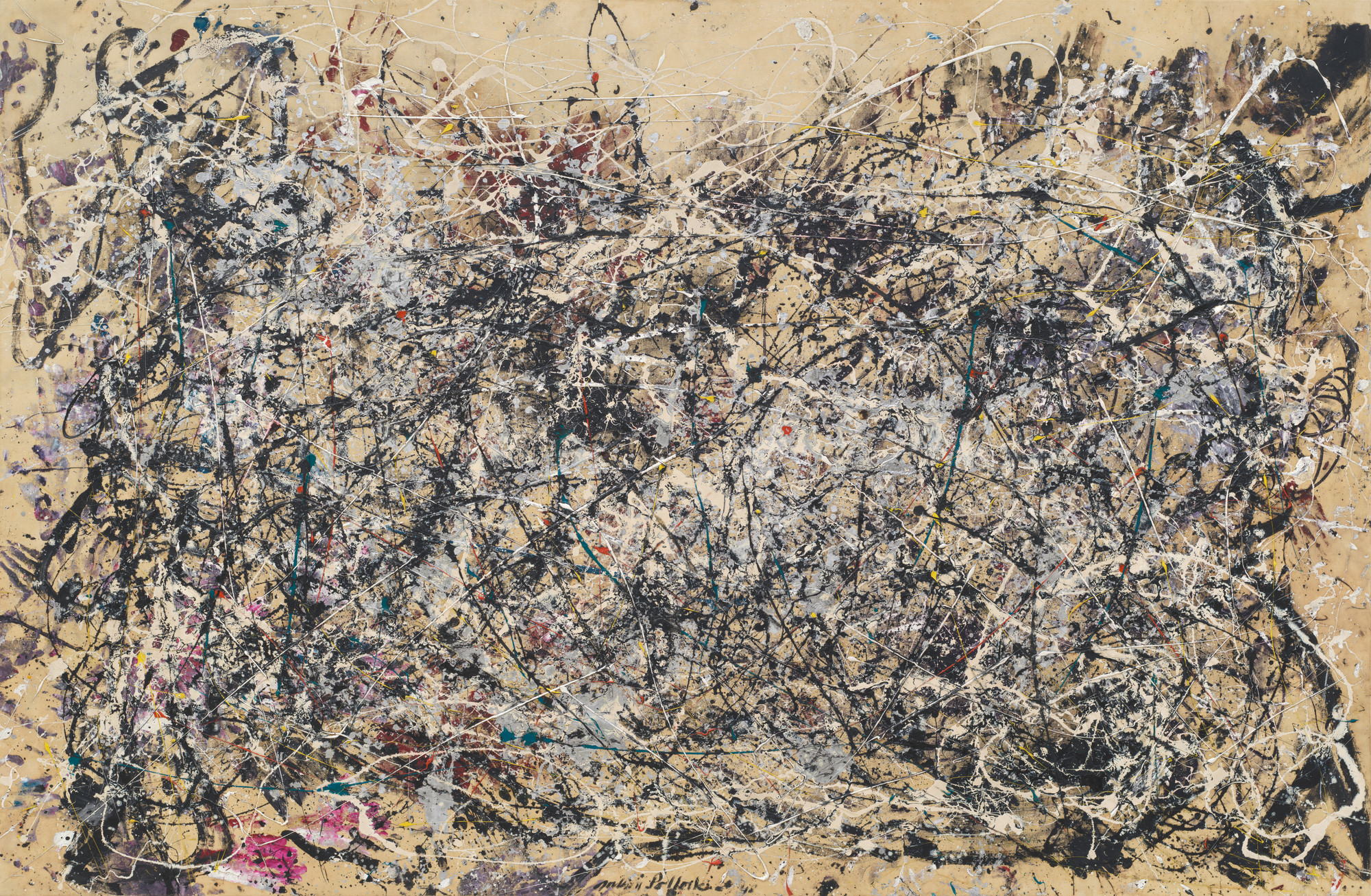
Fast-forward to mid-century America, where Jackson Pollock revolutionized the genre with his drip technique. Pollock's chaotic yet controlled pours of paint embodied the raw energy of postwar existentialism. A recent study from Stanford University, published in October 2025, sheds new light on one of his iconic pieces: Number 1A, 1948, housed at the Museum of Modern Art (MoMA) in New York. This painting, a whirlwind of black, white, brown, silver, and primary colors, features enigmatic blue specks that have puzzled conservators for decades. The research, led by chemist Edward Solomon and former PhD student Alex Heyer, identified the pigment as manganese blue—a synthetic compound phased out in the 1990s due to its toxic production process.
What makes this blue so captivating? The team employed advanced scientific methods to unravel the mystery. Initial scans using X-ray fluorescence mapped the painting's elemental composition, pinpointing signatures for yellows and reds but leaving the blue elusive. Deeper analysis involved resonance Raman spectroscopy on microscopic scrapings from the canvas's underside. This technique, which enhances molecular vibrations with laser light, produced a chemical "fingerprint" confirming manganese blue. Further, magnetic circular dichroism (MCD) and computational modeling revealed the pigment's electronic structure: a manganese ion encircled by oxygen atoms creates dual absorption bands that filter out green and violet light, allowing pure blue wavelengths to dominate. As Heyer noted, "There’s actually a really interesting chemical mechanism that’s creating this blue."
Pollock's intuitive choice of manganese blue underscores his mastery. In Number 1A, 1948, the blue daubs punctuate the dense lattice of drips, adding luminosity amid the frenzy. This discovery not only enhances our understanding of Pollock's materials but also highlights the intersection of art and science. Solomon, whose lab typically focuses on biology and catalysis, adapted these tools for art conservation, proving their versatility. The findings, detailed in the Proceedings of the National Academy of Sciences, emphasize how noninvasive technologies can preserve cultural heritage without damaging artworks.
Beyond Pollock, blue abstract painting flourished in the hands of other luminaries. Yves Klein, the French artist obsessed with ultramarine, patented his own hue—International Klein Blue (IKB)—in 1957. Klein's monochromatic canvases, like IKB 79 (1959), immerse viewers in an endless void, symbolizing the immaterial. His anthropometries, where models imprinted blue-painted bodies onto canvas, blended performance with abstraction, pushing boundaries further. Similarly, Mark Rothko's color-field paintings, such as No. 61 (Rust and Blue) (1953), use layered blues to evoke emotional depth, inviting contemplation in chapels and galleries worldwide.
In Europe, Joan Miró infused blue with surreal whimsy. His Blue II (1961), part of a triptych, features sparse black lines against vast azure fields, evoking cosmic expanses. Across the Atlantic, Helen Frankenthaler pioneered soak-stain techniques in pieces like Mountains and Sea (1952), where diluted blues bleed into canvas, mimicking watercolor's fluidity. These artists demonstrate blue's versatility: calming yet intense, grounding yet ethereal.
The science behind blue pigments adds another layer of fascination. Historically, blue was rare and expensive—think Egyptian blue from antiquity or lapis lazuli in Renaissance masterpieces. Modern synthetics like manganese blue revolutionized accessibility, but environmental concerns led to their decline. Today's artists turn to safer alternatives, such as phthalocyanine blue, which offers similar vibrancy without toxicity. Research like Stanford's bridges chemistry and creativity, informing conservation efforts at institutions like MoMA and inspiring new pigment developments for sustainable art.
In contemporary contexts, blue abstract painting thrives in digital and mixed media. Artists like Gerhard Richter blur abstraction with photorealism in squeegee-pulled blues, while digital creators use AI to generate infinite variations. This evolution makes blue abstracts ideal for interior design—think oversized wall pieces that transform living rooms into serene sanctuaries. Collections focusing on Blue Abstract Painting offer hand-painted originals and prints, blending Pollock-esque energy with modern minimalism.
The psychological impact of blue cannot be overstated. Studies from color theory suggest it lowers heart rates and promotes focus, making blue abstracts perfect for workspaces or meditation areas. In Pollock's case, the luminous blue in Number 1A might have subconsciously drawn viewers into his chaotic universe, balancing turmoil with harmony.
As we reflect on Pollock's legacy, the Stanford study reminds us that art's mysteries often yield to science. Yet, the emotional pull of blue abstract painting remains timeless, inviting endless interpretation.
Extending beyond historical figures, today's blue abstracts draw from global influences. In Asia, artists like Zao Wou-Ki fused Eastern ink traditions with Western abstraction in swirling blues, evoking stormy seas. African-American artist Sam Gilliam draped canvas in blue washes, challenging flatness with sculptural forms. These diverse voices enrich the genre, proving blue's universal appeal.
For collectors, blue abstract painting offers investment potential. Pollock's works fetch millions at auctions—Number 1A itself is a MoMA cornerstone. Emerging artists in this style, available through platforms like Saatchi Art, provide accessible entry points. When selecting pieces, consider scale: extra-large formats amplify blue's immersive quality, as seen in dedicated Blue Abstract Painting selections.
The fusion of art and technology opens new frontiers. Virtual reality experiences let users "enter" Pollock's drips, while NFTs digitize blue abstracts for blockchain ownership. Yet, nothing rivals the tactile presence of a physical canvas, where blue's depth unfolds in natural light.
In conclusion, blue abstract painting, from Pollock's revolutionary drips to contemporary innovations, captivates with its emotional and scientific layers. The Stanford revelation on manganese blue not only demystifies a Pollock enigma but also celebrates the color's enduring magic. Whether adorning gallery walls or home interiors, these works remind us of art's power to evoke the ineffable.
FAQ
What pigment was identified in Jackson Pollock's Number 1A, 1948?
The vivid blue was confirmed as manganese blue, a synthetic pigment phased out in the 1990s due to toxicity.
What scientific methods were used in the Stanford study?
Researchers employed X-ray fluorescence, resonance Raman spectroscopy, and magnetic circular dichroism to analyze the pigment's structure.
Why is blue significant in abstract painting?
Blue evokes depth and serenity, used by artists like Pollock and Klein to symbolize the infinite and subconscious.
Who are some key artists in blue abstract painting?
Notable figures include Jackson Pollock, Yves Klein, Mark Rothko, and Wassily Kandinsky, each innovating with blue's emotional range.
Where can I find blue abstract painting for home decor?
Explore collections like Blue Abstract Painting for oversized, hand-painted options.